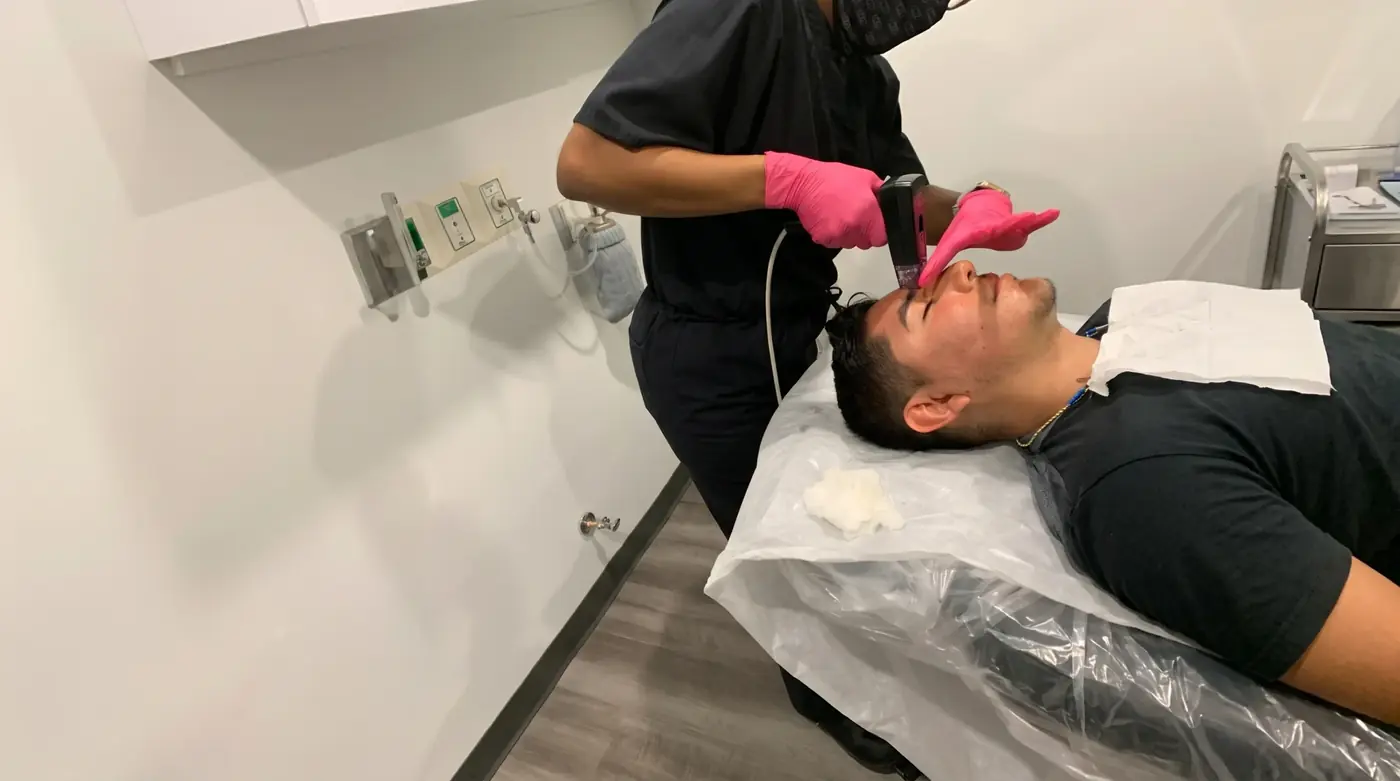
PRP vs. PRF: What’s the Difference and Why Rejuvenescence Uses Only Natural Fillers

By Dr. Karin Davis, DMD, MPAS, PA-C | Rejuvenescence Med Spa, Duluth, GA
When patients come to Rejuvenescence for facial rejuvenation, one of the first things they notice is that we do not offer hyaluronic acid fillers. No Juvederm. No Restylane. No Sculptra. This is not an oversight. It is a deliberate clinical philosophy: we believe the best material to restore your face is your own biology.
Instead, we use PRP (platelet-rich plasma) and PRF (platelet-rich fibrin), two regenerative injectables derived from a small sample of your own blood. Both harness your body's natural growth factors to stimulate tissue repair and collagen production. But they are not the same, and choosing between them matters clinically. Here is the complete explanation.
Contents
What Is PRP?
Platelet-rich plasma is produced by drawing a small blood sample, spinning it in a centrifuge at high speed to separate the components by density, and extracting the plasma layer concentrated with platelets. This platelet-rich fraction is then injected into the treatment area.
Platelets are best known for clotting, but they also contain a rich payload of growth factors including PDGF, VEGF, TGF-beta, and EGF, signaling proteins that orchestrate tissue repair and regeneration. When injected into aging or damaged tissue, these growth factors stimulate fibroblast activity, collagen synthesis, and new blood vessel formation.
PRP is liquid in consistency, making it injectable through fine needles into a wide range of treatment areas. It has a relatively short tissue retention time because it is rapidly metabolized, but its growth factor payload is released quickly and potently.
What Is PRF?
Platelet-rich fibrin is a second-generation refinement of PRP that uses a different centrifugation protocol, slower spin speed and no anticoagulant additives, to produce a more complex biological matrix. The result is a gel-like material that contains not only platelets and growth factors but also a three-dimensional fibrin scaffold threaded with white blood cells and stem cells.
This fibrin matrix is what distinguishes PRF from PRP clinically:
- Slower, sustained growth factor release: the fibrin scaffold acts as a natural reservoir, releasing growth factors gradually over 7 to 14 days rather than all at once. This more closely mimics the body's natural healing timeline and produces a more sustained regenerative response
- Gel-like consistency: PRF can be used as a soft tissue filler that provides mild immediate volume while simultaneously stimulating collagen over weeks and months. In its gel form, it can be injected into the under-eye area, nasolabial folds, lips, and other areas that benefit from both immediate lift and long-term regeneration
- Stem cell and white blood cell content: the inclusion of these additional cellular components enhances the regenerative and anti-inflammatory response beyond what PRP alone provides
PRP vs PRF: Side-by-Side Comparison
| PRP | PRF | |
| Centrifugation speed | High speed | Lower speed (no anticoagulants) |
| Consistency | Liquid | Gel (can be used as filler) |
| Growth factor release | Rapid, concentrated burst | Slow, sustained (7-14 days) |
| Fibrin scaffold | No | Yes |
| Stem cells included | Minimal | Yes |
| White blood cells | Minimal | Yes |
| Immediate volume | Minimal | Mild (gel form) |
| Duration of effect | Shorter | Longer (collagen builds for months) |
| Best applications | Scalp, microneedling, joint injection | Face, under-eye, lips, skin rejuvenation |
| Available at Rejuvenescence | Yes | Yes |
Why Rejuvenescence Uses Only PRP and PRF
Most aesthetic practices use hyaluronic acid (HA) fillers like Juvederm and Restylane as their primary volume restoration tools. These are safe, effective, and reversible, and there is nothing inherently wrong with them. So why do we choose not to offer them?
Our philosophy is grounded in Dr. Davis's dual training in oral and maxillofacial surgery and aesthetic medicine. From a surgical perspective, the most durable and natural-looking outcomes come from supporting and regenerating the body's own structures rather than adding foreign material to them. HA fillers add volume externally. PRP and PRF stimulate your own tissue to produce and rebuild.
Practical reasons we prefer natural fillers:
- No foreign material: PRP and PRF are derived entirely from your own blood, eliminating the risk of foreign body reactions, delayed hypersensitivity, or biofilm formation that can occur with any synthetic filler
- Genuine regeneration rather than masking: HA fillers fill space. PRF stimulates collagen and elastin production, improving the quality of the skin itself over time rather than simply adding volume beneath it
- Progressive natural improvement: results build gradually over weeks and months as new collagen matures. The result looks natural because it is natural
- No reversal needed: because there is no synthetic material injected, there is no risk of the complications associated with HA migration or the need for enzymatic reversal
Patients who choose Rejuvenescence understand that they are choosing a different philosophy: slower, gradual, natural improvement built on their own biology rather than immediate volume from synthetic material. This is not better or worse than HA fillers universally. It is better for patients who share this philosophy.
What Can PRP and PRF Treat?
PRF as a Natural Filler
- Under-eye rejuvenation: PRF gel addresses the hollowing and dark circles of the tear trough without the risk of Tyndall effect (bluish discoloration) that can occur with HA fillers in this delicate area
- Nasolabial folds and marionette lines: gradual collagen stimulation in fold areas improves skin quality and mild to moderate depth
- Lip enhancement: subtle, natural-looking lip volume and improved perioral skin quality
- Cheek and mid-face: mild volume restoration with significant skin quality improvement over 3 to 6 months
PRP Combined with Other Treatments
PRP is also used at Rejuvenescence in combination with Morpheus8 RF microneedling, applied topically or injected immediately following the microneedling session to amplify collagen stimulation and accelerate skin healing. This combination is one of our most popular regenerative protocols.
Who Is the Right Candidate for Natural Fillers?
- Patients who prefer regenerative, biologic treatments over synthetic materials
- Patients with mild to moderate facial volume loss, hollowing, or skin laxity
- Patients who have had reactions or concerns with HA fillers previously
- Patients who want progressive, natural-looking improvement over 3 to 6 months rather than immediate dramatic results
- Patients combining regenerative injectables with Morpheus8, Emface, or AccuTite for a comprehensive non-surgical facial rejuvenation approach
We serve patients throughout Duluth, Johns Creek, Suwanee, Norcross, and Gwinnett County, GA. Rejuvenescence is located at Duluth, Georgia, and consultations can be requested online.
Interested in Natural Filler Options at Rejuvenescence?
Schedule a consultation with Dr. Karin Davis at Rejuvenescence Med Spa in Duluth, GA. She will evaluate your facial anatomy and goals and recommend whether PRP, PRF, or a combination approach is the right fit for your rejuvenation plan.
Rejuvenescence Med Spa | Duluth, GA
Request Your Consultation at Rejuvenescence
Medical Disclaimer: This article is for informational purposes only and does not constitute medical advice. Individual results vary. Please consult with a qualified healthcare provider before beginning any treatment.
Frequently asked questions
Which lasts longer, PRP or PRF?
PRF generally produces more lasting results than PRP because its fibrin scaffold releases growth factors slowly over 7 to 14 days, stimulating a more prolonged and sustained collagen response. PRF used as a filler provides mild immediate volume that fades over weeks, while the collagen it stimulates continues to improve skin quality for 3 to 6 months. PRP's growth factor release is faster and more concentrated but less sustained.
Is PRF better than HA fillers?
PRF and HA fillers serve different goals. HA fillers provide immediate, significant volume that is visible right away and lasts 6 to 18 months. PRF provides mild immediate volume with progressive regenerative improvement in skin quality over months. PRF is not a replacement for HA fillers when immediate substantial volume is needed; it is an alternative for patients who prefer biologic, natural approaches and are comfortable with gradual improvement.
Does PRP or PRF hurt?
Both involve a blood draw and injections, which most patients find manageable. Topical numbing cream is applied before injection to minimize discomfort. The blood draw is the same as any standard blood test. Post-treatment, mild bruising, swelling, and tenderness at injection sites are common and typically resolve within a few days.
How many PRP or PRF sessions are needed?
Most patients complete an initial series of 2 to 3 sessions spaced 4 to 6 weeks apart for optimal collagen stimulation. Maintenance sessions every 6 to 12 months help sustain results as the natural aging process continues. The number of sessions and the treatment protocol are customized during your consultation with Dr. Davis.
Does Rejuvenescence offer PRP and PRF in Duluth, GA?
Yes. Rejuvenescence Med Spa in Duluth, GA uses only natural PRP and PRF fillers for facial rejuvenation, under the care of Dr. Karin Davis, DMD, MPAS, PA-C. We serve patients throughout Gwinnett County, including Johns Creek, Suwanee, and Norcross.
Last updated: