FaceTite vs. Facelift: Which Is Right for You?

Reviewed by Dr. Karin Davis, DMD, MPAS, PA-C | Rejuvenescence Med Spa, Duluth, GA
The desire for a more defined jawline, firmer neck skin, and a lifted facial contour is one of the most common aesthetic goals among adults in their 40s, 50s, and 60s. For decades, the surgical facelift was the only truly effective answer. Today, it is not. FaceTite has changed the conversation by delivering meaningful skin tightening and fat reduction through a minimally invasive procedure that requires no general anesthesia, no large incisions, and a fraction of the recovery time.
But FaceTite and a traditional facelift are not equivalent. They serve different patients, address different degrees of laxity, and produce results of different scope. Understanding the distinction is the foundation of making the right decision for your anatomy, goals, and life circumstances.
At Rejuvenescence Med Spa in Duluth, Georgia, Dr. Karin Davis brings a rare combination of credentials to this decision: dual board certification in oral and maxillofacial surgery and as a physician assistant with extensive training in aesthetic medicine. Her surgical background means she understands both procedures from the inside out and can give patients an honest, anatomy-based recommendation rather than a sales pitch.
Contents
What Is FaceTite?
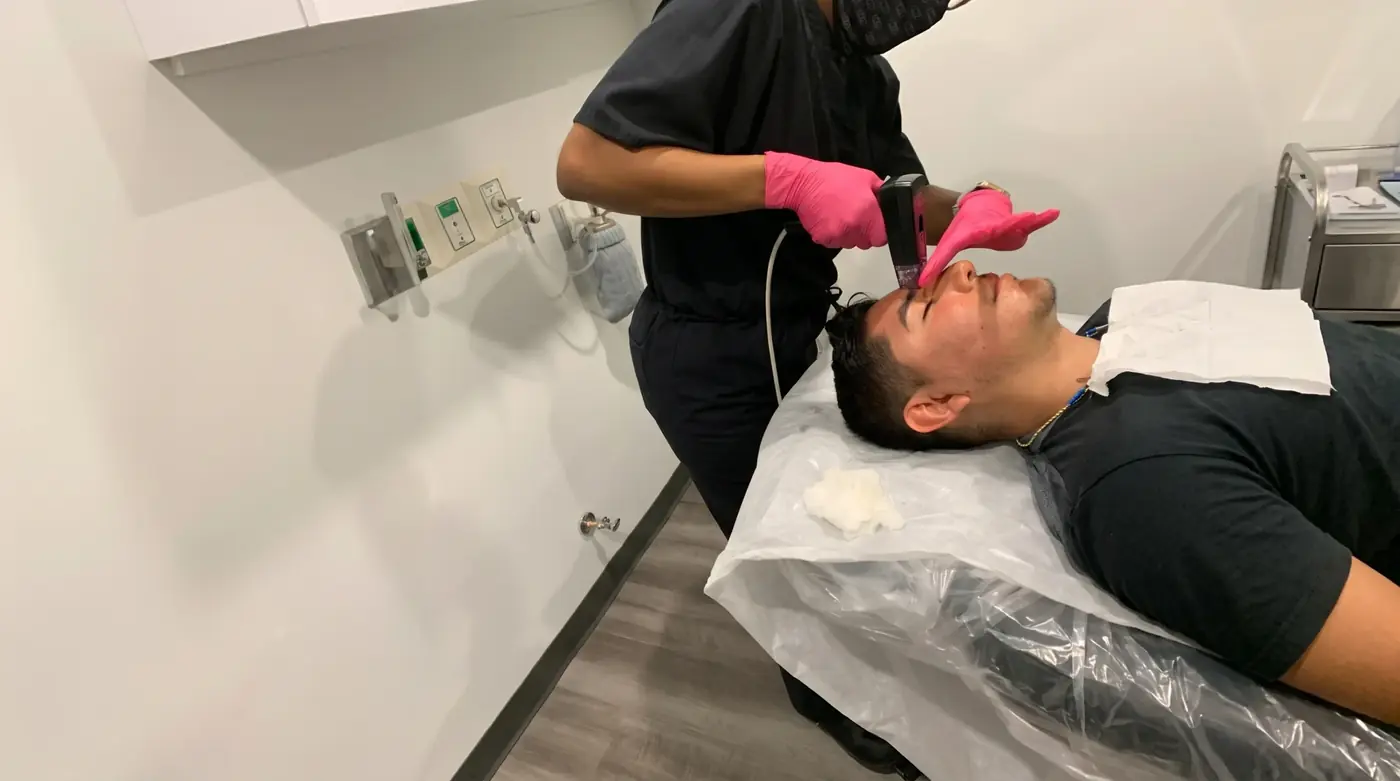
FaceTite is a minimally invasive radiofrequency-assisted lipolysis (RFAL) procedure developed by InMode. A very small cannula, roughly the diameter of a pen tip, is inserted through a tiny incision (typically 1 to 2mm) beneath the skin. The device simultaneously delivers radiofrequency energy to the underside of the skin and the skin surface, creating controlled thermal injury that accomplishes three things:
- Liquefies and removes localized fat deposits in treated areas
- Contracts existing collagen fibers immediately, producing visible tightening
- Stimulates new collagen production over the following months, improving skin quality and firmness progressively
FaceTite is most commonly used to address the lower face, jowls, neck, and submental area (under the chin). It can also be used on the mid-face and brow region. A related technology, AccuTite, uses the same RFAL mechanism at a smaller scale for more delicate or localized areas such as the nasolabial folds, periorbital region, or specific pockets of fat that require precision beyond what a standard FaceTite handpiece can provide.
What Is a Traditional Facelift?
A rhytidectomy, commonly called a facelift, is a surgical procedure performed under general or deep sedation anesthesia by a licensed surgeon. The surgeon makes incisions typically along the hairline and around or behind the ears, lifts and repositions the underlying facial structures including the SMAS (superficial musculoaponeurotic system) layer, removes excess skin, and sutures the incisions closed.
A full facelift addresses the most significant facial aging changes: deep jowling, substantial skin redundancy, and significant descent of the midface. It produces the most dramatic and longest-lasting results of any facial rejuvenation procedure. However, it also carries the greatest risks, requires general anesthesia, produces visible scarring (ideally well-concealed), and demands a recovery period of two to four weeks before patients are comfortable returning to social and professional activities.
FaceTite vs. Facelift: Side-by-Side Comparison
| FaceTite | Traditional Facelift | |
| Procedure Type | Minimally invasive (micro-incision) | Surgical (incisions along hairline/ears) |
| Anesthesia | Local anesthesia with sedation | General or deep sedation anesthesia |
| Incision Size | 1 to 2mm entry points | Several centimeters, concealed in hairline |
| Fat Removal | Yes (simultaneous lipolysis) | Sometimes (if combined with liposuction) |
| SMAS Repositioning | No | Yes (structural lift) |
| Skin Tightening | Significant (RF contraction + collagen) | Significant (mechanical lift + excision) |
| Recovery Time | 3 to 7 days for most activities | 2 to 4 weeks |
| Visible Scarring | Minimal (micro-entry points) | Potential (concealed in hairline/ears) |
| Results Timeline | Immediate + progressive (3 to 6 months) | Immediate + maturation (3 to 6 months) |
| Results Duration | 3 to 5 years typically | 7 to 10 years typically |
| Ideal Degree of Laxity | Mild to moderate | Moderate to severe |
| Performed at Rejuvenescence | Yes | No (referral to surgeon) |
Who Is the Right Candidate for FaceTite?
FaceTite produces its best results in patients who have:
- Mild to moderate skin laxity in the lower face, jowls, or neck
- Localized fat deposits contributing to jowling, a double chin, or loss of jawline definition
- Skin that still retains reasonable elasticity and can contract in response to heat stimulus
- A preference for avoiding general anesthesia and extended recovery
- Goals that include natural-looking improvement rather than dramatic transformation
- Age range typically 35 to 60, though individual anatomy matters more than age
FaceTite is not a replacement for a facelift in every patient. For patients with significant skin redundancy, heavy jowling, or substantial descending of facial structures, a surgical facelift remains the more appropriate option. Dr. Davis provides an honest assessment during consultation and will refer patients to a surgical colleague when surgery is genuinely the better path.
Who Is the Right Candidate for a Facelift?
A traditional facelift produces results that FaceTite cannot fully replicate for patients with:
- Moderate to severe facial skin laxity with significant excess skin
- Deep jowling that extends substantially below the jawline
- Significant descent of the midface and cheek fat pads
- Neck skin redundancy requiring actual skin removal, not just contraction
- A desire for the longest-lasting possible result and willingness to accept surgical recovery
Results: What to Realistically Expect
FaceTite Results
Patients typically notice immediate improvement in contour following FaceTite due to fat removal and initial collagen contraction. The most significant improvements develop over three to six months as new collagen matures and skin continues to contract and tighten. Clinical studies report average skin contraction of 35 to 45% in treated areas, along with meaningful reduction in submental fat.
Results are real and visible. Most patients appear refreshed and more defined without looking dramatically different or obviously treated. The hallmark of a well-performed FaceTite result is that friends and colleagues notice the patient looks better without being able to identify exactly why.
Facelift Results
A well-performed facelift by an experienced surgeon produces the most structurally significant facial rejuvenation available. Midface descent is corrected, jowls are lifted, neck skin is tightened, and the overall facial contour is restored to a position 10 to 15 years earlier in many patients. Results typically last 7 to 10 years before significant re-aging occurs, though lifestyle factors, sun protection, and skincare practices meaningfully influence longevity.
Recovery: The Practical Difference
FaceTite Recovery
- Most patients experience swelling and bruising for 3 to 5 days
- A compression garment is worn for 1 to 2 weeks
- Most patients return to desk work within 3 to 5 days
- Strenuous activity resumed at 2 to 3 weeks
- Final contraction and result visible at 3 to 6 months
Facelift Recovery
- Initial healing requires 1 to 2 weeks before most social interactions are comfortable
- Sutures removed at approximately one week
- Most patients return to professional activities at 2 to 3 weeks
- Residual swelling may persist for 6 to 12 weeks
- Final results visible at 3 to 6 months as swelling fully resolves
Can FaceTite and a Facelift Be Combined?
In some cases, yes. FaceTite is occasionally used in conjunction with a surgical facelift to address fat deposits and skin laxity in areas that the mechanical lift alone does not fully correct. This combination approach is typically performed by a surgeon who incorporates FaceTite into the surgical procedure, not at a med spa setting.
At Rejuvenescence, FaceTite is performed as a standalone procedure. For patients who appear to need more correction than FaceTite can provide, Dr. Davis will discuss surgical referral options during the consultation process.
Where Does FaceTite Fit in the Full Treatment Spectrum?
It helps to think of facial rejuvenation options on a spectrum of invasiveness and correction:
- Non-invasive (no downtime): Morpheus8 RF Microneedling, Emface, Exion RF Face, Botox, fillers
- Minimally invasive (days of recovery): FaceTite, AccuTite
- Surgical (weeks of recovery): Traditional facelift, neck lift, deep plane facelift
FaceTite occupies a meaningful middle ground that did not exist a decade ago. It delivers results that exceed what non-invasive treatments can achieve, without the recovery, anesthesia risk, or commitment of surgery. For the right patient, it is a genuinely transformative option.
Why Dr. Davis’s Background Matters for This Decision
Most aesthetic providers who perform FaceTite have no surgical training and therefore no framework for comparing it to surgery with clinical accuracy. Dr. Karin Davis's dual credentials in oral and maxillofacial surgery and aesthetic medicine give her a genuinely unique perspective: she understands the structural anatomy that both FaceTite and facelift address, the limitations of each, and the honest profile of patients who will and will not benefit from minimally invasive treatment.
At Rejuvenescence, the consultation is where this expertise matters most. Dr. Davis evaluates facial anatomy, skin quality, degree of laxity, fat distribution, and the patient's goals and lifestyle to make a recommendation grounded in clinical judgment. Patients across Duluth, Johns Creek, Suwanee, and Norcross, GA choose Rejuvenescence for exactly this level of medical precision.
Not Sure Which Approach Is Right for Your Face?
Schedule a consultation at Rejuvenescence Med Spa in Duluth, GA. Dr. Davis will evaluate your facial anatomy and give you an honest, clinically-grounded recommendation: whether that points to FaceTite, a non-invasive treatment, or a surgical referral.
Request Your Consultation at Rejuvenescence Med Spa.
Medical Disclaimer: This article is for informational purposes only and does not constitute medical advice. FaceTite is a minimally invasive medical procedure requiring physician evaluation and administration. Individual results vary. Please consult with a qualified provider before pursuing any aesthetic treatment.
Frequently asked questions
Is FaceTite as effective as a facelift?
For patients with mild to moderate laxity, FaceTite can produce results that are genuinely impressive and, in some cases, sufficient to delay or avoid the need for surgery. For patients with moderate to severe laxity, significant skin redundancy, or descended facial structures, a facelift typically produces more comprehensive correction. The right answer depends entirely on your anatomy, which is why a clinical evaluation matters more than any general comparison.
How long does FaceTite last?
FaceTite results typically last 3 to 5 years. Because it stimulates real collagen production rather than simply removing fat, the results include genuine structural improvement that persists. Individual longevity depends on factors including age, skin quality, sun protection habits, and whether the patient maintains a stable weight.
Is FaceTite painful?
FaceTite is performed under local anesthesia with optional oral or IV sedation for comfort. Most patients describe the procedure as comfortable, with a warm sensation during treatment. Post-procedure discomfort is typically mild and managed with over-the-counter pain relief. The absence of general anesthesia eliminates many of the risks and aftereffects associated with surgical procedures.
Can I have FaceTite if I have had a facelift in the past?
In many cases, yes. FaceTite can be used to address the ongoing aging that occurs in the years following a surgical facelift, particularly in the lower face and neck where early re-laxity tends to appear first. Dr. Davis evaluates each patient individually to determine whether post-surgical anatomy is appropriate for FaceTite treatment.
Does Rejuvenescence Med Spa offer FaceTite in Duluth, GA?
Yes. FaceTite and AccuTite are both available at Rejuvenescence Med Spa under the care of Dr. Karin Davis in Duluth, Georgia. We welcome patients from throughout Gwinnett County, including Johns Creek, Suwanee, and Norcross. Contact us to schedule a consultation and determine whether FaceTite is the right approach for your goals.
Last updated: